Showing posts with label denalism. Show all posts

Record-High Antarctic Sea Ice Levels Don't Disprove Global Warming

The region's ice has weathered global warming better than Arctic ice

Steve Goddard must be feeling shell shocked. Only a few months ago at the winters peak, the Arctic Sea Ice extent (not volume) was almost normal which he touted loudly on his blog, only to see the fastest melt on record to a new low. With the Battle lost he turns his attention to the Antarctic winter and the growing ice there.

This is a repost from SKYE at weather.aol.com
(Credit: Jeremy Potter NOAA/OAR/OER)
Distracting from the news that Arctic sea-ice extent reached a record low on Sept. 16 is a widely circulating blog article claiming that at the opposite end of the Earth, Antarctic sea ice is more than making up for the losses.

In the post, climate change skeptic and blogger Steven Goddard states that Antarctic sea ice reached its highest level ever recorded for the 256th day of the calendar year on Sept. 12. He reasons that the Southern Hemisphere must be balancing the warming of the Northern Hemisphere by becoming colder (and thus, net global warming is zero).

The National Snow & Ice Data Center (NSIDC), which tracks sea ice using satellite data, explains on its website why Antarctic ice has weathered global warming more robustly than Arctic ice. Goddard dismisses the explanation, concluding instead, "Antarctic and Arctic ice move opposite each other. NSIDC's dissonance about this is astonishing."

Despite its lack of scientific support, Goddard's post has garnered attention around the Web. In a Forbes.com column about the record high Antarctic sea ice, skeptic James Taylor writes, "Please, nobody tell the mainstream media or they might have to retract some stories and admit they are misrepresenting scientific data."

But if anyone had asked an actual scientist, they would have learned that a good year for sea ice in the Antarctic in no way nullifies the precipitous drop in Arctic sea-ice levels year after year - or the mounds of other evidence indicating global warming is really happening.

"Antarctic sea ice hasn't seen these big reductions we've seen in the Arctic. This is not a surprise to us," said climate scientist Mark Serreze, director of the NSIDC. "Some of the skeptics say 'Well, everything is OK because the big changes in the Arctic are essentially balanced by what's happening in the Antarctic.' This is simply not true." [Former Global Warming Skeptic Makes a 'Total Turnaround']

Projections made from climate models all predict that global warming should impact Arctic sea ice first and most intensely, Serreze said. "We have known for many years that as the Earth started to warm up, the effects would be seen first in the Arctic and not the Antarctic. The physical geography of the two hemispheres is very different. Largely as a result of that, they behave very differently."

The Arctic, an ocean surrounded by land, responds much more directly to changes in air and sea-surface temperatures than Antarctica, Serreze explained. The climate of Antarctica, land surrounded by ocean, is governed much more by wind and ocean currents. Some studies indicate climate change has strengthened westerly winds in the Southern Hemisphere, and because wind has a cooling effect, scientists say this partly accounts for the marginal increase in sea ice levels that have been observed in the Antarctic in recent decades.

"Another reason why the sea-ice extent in the Antarctic is remaining fairly high is, interestingly, the ozone hole," Serreze told Life's Little Mysteries. This hole was carved out over time by chlorofluorocarbons, toxic chemicals formerly that were used in air conditioners and solvents before being banned. "The ozone hole affects the circulation of the atmosphere down there. Because of the ozone hole, the stratosphere above Antarctica is quite cold. Ozone in the stratosphere absorbs UV light, and less absorption [by] ozone makes the stratosphere really cold. This cold air propagates down to the surface by influencing the atmospheric circulation in the Antarctic, and that keeps the sea ice extensive."

But these effects are very small, and Antarctic sea-ice levels have increased only marginally. In the coming decades, climate models suggest rising global temperatures will overwhelm the other influences and cause Antarctic sea ice to scale back, too.

The extent of Arctic sea ice at its summertime low point has dropped 40 percent in the past three decades. The idea that a tiny Antarctic ice expansion makes up for this - that heat is merely shifting from the the Southern Hemisphere to the Northern and therefore global warming must not be happening - is "just nonsense," Serreze said.

Losing Your Own Argument With Your Own Argument

It takes someone really special to achieve this. And we have someone very special indeed - Suyts.

He recently had a moan about Prof. Mann's threat to sue the National Review for libellous comments in an article, but even though Mann has every right to use the courts to protect his reputation, Suyts believes that to stoop to saying “I’ll sue!!!!” "is what happens when you lose the intellectual argument".


Problem is that if this is true then Suyts along with Lord Monckton have already lost the intellectual argument because we all know how keen the Lord is in threatening litigation and Suyts fully supports it.

Yep, it takes a special person to lose an argument with yourself.

Warmer In The Thirties - I think NOT

A regular commenter on the Orwellian named 'Real Science' is someone called suyts who has merited a mention on Really Sciency before for his ‘some pale shading’ and his warped logic achieving 'muppet' status. Well this guy has his own blog which reaches a whole new level of crazy.

Recently the 'syuts place' blog made a very specific claim - "Arctic Was Warmer In The Thirties!!". Yes the two exclaimation marks were his just to show how significant he wanted the claim to be considered. He even included graphs picked out from actual credible sourses to prove it;

"I added the thick black line" appears on the NASA version by suyts.
The actual source for his graph is Warming Trends in the Arctic from Clear Sky Satellite Observations, JOSEFINO C. COMISO, from NASA Goddard Space Flight Center which appeared in Journal of Climate way back in 2003, via NASA's "Evidence of Arctic Warming" page.

It is true that the 'thick black line' shows that the temperature trend was higher in the thirties than it is by the end of the graph. However if you read the paper you find that Comiso and the research fully support the global warming theory - as does NASA. There is no doubt about this and the Abstract clearly states;
The longer-term in situ surface temperature data shows that the 20-yr trend is 8 times larger than the 100-yr trend suggesting a rapid acceleration in the warming that may be associated with the recent change in phase of the Arctic Oscillation that has been linked to increasing greenhouse gases in the atmosphere.
So basically suyts has cherry picked a graph, altered it a little and taking it out of context has added his own denial spin that is totally at odds from the actual published research - a typical tactic when no real research supports your beliefs.

But is there any evidence that the Arctic Was Warmer In The Thirties?

I commented on suyts post to make two specific points;

First, as another poster, uknowispeaksense, (whose rather good blog I have been following for a while), says: "So What?" Cherry picking one area to suggest something significant about Global temperatures is wrong on so many levels. It a tired old tactic. Find an area that might just be bucking the trend for now and highlight it. Then when challenged claim that you were never suggesting it related to anything else. Of course if this were true and the person was honest, this would have been stated from the outset - "This area was warmer in the past than it is today - even though most other areas have warmed more now". This sort of level of openness and honesty is rarely found in those who are desperate to find something to support their beliefs.

So simply put, even if suyts is correct in his statement that the "Arctic Was Warmer In The Thirties", (and he isn't as I will show), without a global context the statement is as significant as saying refrigerators were as warm in the thirties. 

The second point I wanted to make is obvious to anyone with the slightest hint of real scepticism. The graph presented stops over a decade ago. I included a link showing more recent temperatures from NOAA's Arctic Report Card. This is from 2011;

This time the black line has been added by me


It clearly shows that while the peak trend in thirties was high in 2000, where Comiso's data ends, that by 2003 the temperature trend exceeds any in the record. Natural variation still causes the temperature to drop below my line but the overall direction of the trend is clear and with 2012 so far the warmest recorded for the Northern Hemisphere I strongly suspect that trend is likely to continue.

So what response does someone get from suyts for highlighting more recent data that clearly shows that the Arctic was NOT warmer in the thirties?
"I thought it was you guys who put so much stock in “peer-review”."
 I assume that this response is because the NOAA graph is from their report card and suyts graph is cherry picked and  misrepresented from research that is totally at odds from his beliefs.

He also replied;
"warmists, for some reason, don’t like this graph. They aren’t very explicit as to why"
Clearly Language comprehension isn’t his strong suit and the meaning of  “the graphs presented stop over a decade ago” was out side his range of understanding. I then asked him specifically “Do you accept that the recent temperature data for the area shows your headline to be false?” His direct answer was No. The graphed data demonstrably shows that he is wrong. His reasoning was bizarre;
"Now, using the same data set as COMISO, show that I’m wrong."
Why would I have to show him wrong? It must be accepted from the data I presented that his headline clearly is wrong. Logic would state it is up to him to present evidence to the contrary, especially since he had presented no recent data to support his recent claim. A bit like stating flared trousers are the height of fashion and proving with a picture from the 1970s.

suyts  - height of fashion?

 As for using the same data that was used in the Comiso paper, that data ended in 2000 but it was data approved by NASA just as the data used in the NOAA graph - except of course that data was more current.

There was of course a lot more rambling but none of it provided any support for the Warmer In The Thirties claim. Undeterred by his irrational nonsense I decided to spell out what would be acceptable evidence
"The NOAA document I have linked shows Arctic up to 2010 and clearly shows a peak about 0.7 kelvin above the 30s peak. By all means show ANY data from a recognised source covering the same area and time frame you prefer if you can find any actually showing the ‘Arctic Was Warmer In The Thirties’."
 It was at this point that he started to believe he was Batman!
Wholly crap Laz! ...  What is implicit throughout the entire post and comments are that none of the present data sets show what was once shown. Notice how your NOAA offering butchers the data?
Ah, so that's it. A conspiracy, the data has been manipulated in nefariousness ways. I actually knew this was coming because in a previous comment I stated I was "not really interested in any conspiracy nonsense" he would concoct. The psychological problem with those that believe in conspiracy theories is that by necessity they do not think them a conspiracy. I'm not suggesting that he is wrong about data adjustments. They are necessary to reduce uncertainties as the science improves. The problem is that the conspiracy theorist will always believe that they have either been altered to prove them wrong or not altered, (in the case of not compensating enough for the heat island effect), to not prove them right.

But even looking at the two graphs he is still wrong. Below you will see the two graphs taken from the original sources one overlayed on top of the other. I have squashed and stretched the images as necessary to get both scales to align. The only other alteration I have done is to alter the contrast to highlight the trend over the variation on one graph and coloured the other graph red so that differences can be easily seen. The graphs track each other very well. There is no indication that the one showing recent data (red) has been manipulated in such a way as to make the past colder, as I suspect suyts is trying to insinuate, in fact the older graph in black could be a trend of the other.  If anyone doubts it do the exact same exercise and align up the scales.


It is crystal clear from the data that the warming trend continues into the next decade, as it does in all recognised temperature data sets. Guess what? The Arctic Was NOT Warmer In The Thirties!

However I'm still certain that suyts will claim that the recent data is unreliable. But there is a simple point of logic here; If we chose to believe over reason that the data is unreliable, how can it be claimed that it was cooler than any previous time?


Oh dear poor suyts;

Even Half a Brain Makes You Over Qualified

The globe isn’t warming any more.

This may have come as a shock to anyone with a brain but it's true. I know you might be wondering about certain facts you may have heard like the Global temperature from GISS, HADCRUT , RSS, UAH and BEST all showing a long term warming trend or that nine of the 10 hottest years occurred since 2000.

But don't let all that empirical evidence and your common sense get in the way, the globe isn't warming anymore because it says so in a recent Real Science post. To comment and suggest this claim is a joke means, according the great intellectual Mr. Goddard, that you only have half a brain.

Then again perhaps Goddard is wrong (yet again) and having even half a brain makes you over qualified to have a rational debate with him and most of his followers, as none at the time of writing has had the sense to query such and absurd and unfounded claim, some even appear to support him!

Real Science Proves Hansen Correct Again.

In a Real Science post, as usual aimed more at right wing politics than real science, Steve Goddard quotes James Hansen from 1986;
"Within 15 years, said Goddard Space Flight Centre honcho James Hansen, "global temperatures will rise to a level that hasn't existed on Earth in 100,000 years"
 Mr Goddard should look rather foolish as Hansen was right. Antarctic Ice Cores from Vostok  revealing temperatures going back 800,000 years show that present temperatures are warmer than at any time in over the last 100,000 years. This is something that was unknown to science back in 1986, so whether Hansen made a lucky guess or an inspired one, he was right.

This figure shows historical CO2 (right axis) and reconstructed temperature (as a difference from the mean temperature for the last 100 years) records based on Antarctic ice cores, providing data for the last 800,000 years.
 
This isn't the fist time Goddard has shown Hansen to be correct even though he remains in denial. Like many foolish people Goddard doesn't know when to quit and his defence of this evidence is to incorrectly insist that;
"According to ice cores, temperatures peaked 8,000 years ago"
 This is an old denier fallacy which was promoted by people like Don Easterbrook and long debunked by sites like Skeptical Science. 8000 years was a warm period and Easterbrook presented graphs like this one that that showed just that;


But as can be clearly seen, Easterbrooks 'present ' times stopped in 1855 just as current global temperatures started to rise. It would be rather inconvenient for a science denier to include modern temperatures and highlight that present warming really is at an unprecedented high, not seen for many thousands of years. Clearly Goddard and his other foolish promoters of myths are living in the past as current average global temperatures are higher than 8000 years ago and as shown higher than over 100,000 years ago just as Hansen said they would be.
 "There are two kinds of fools: those who can't change their opinions and those who won t."

Goddard's Appeal to Athority

Steve Goddard continues to misrepresent Hansen to misinform his readers, and probably himself.

As previously reported he accuses Hansen of calling or declaring a permanent drought in the US, when what Hansen actually said was, there would be a semi-permanent drought over the next several decades with rain, when it does come, occurring in extreme events with heavy flooding.

He repeated a similar claim in his 'Warming To Bring Permanent Drought And Permanent Flood To The Midwest' post and said;
 "No sooner than Hansen declared permanent drought for the midwest – we get a new global warming report warming of permanent floods in the midwest."

Well as  anyone can see Hansen has never declared a permanent drought and certainly no drought for this present time. Nor has there been any war(n)ing of permanent floods. Why does Goddard feel the need to make this easily refuted stuff up?

Just to reiterate, what we have is drought conditions being alleviated somewhat by heavy rain. Doesn't that fit exactly what Hansen suggests will happen over the next several decades?
“Over the next several decades, the Western United States and the semi-arid region from North Dakota to Texas will develop semi-permanent drought, with rain, when it does come, occurring in extreme events with heavy flooding.”

But it gets better. When I said "Shouldn’t that be Semi-permanent drought over several decades?", Mr Goddard replied with his usual politeness;
" I have been hearing the exact same crap for three decades already."

So straight away on being challenged Goddard drops the permanent drought claim - though don't hold your breath for a correction.

It seemed only fair that I should suggest he provide a quote of Hansen saying 'the exact same crap' three decades ago and he kindly provided a link to this news article about US drought in 1988;

Now any one with a keen intellect will immediately realise, (sorry Mr Goddard that can't include you), that 1988 can't be said to be three decades ago.

The article itself is also an interesting read in light of Goddard's claim. Although Hansen is quoted in it, and there is a quote "It is an example of the kind of drought that will occur more frequently as global warming become larger", this wasn't said by Hansen, but Manabe, a soil specialist.

However, something I found rather amusing happened in our conversation when I asked Goddard if he really did think 1988 was three decades ago. He replied in his usual amiable way;
"You are a know nothing idiot child. I was working on global warming studies at Los Alamos in 1980."
Well 1980 is over three decades ago so I will give him that but perhaps he should have quoted his own published Global Warming research instead of a news article eight years later.

Blow me, isn't that a prime example of the Fallacy: Appeal to Authority? Only using Goddard's view of his own self importance to make himself the authority?


Hansen Forecast Verification

Goddard likes to twist the truth to align it with is ideology. In a recent post called "Hansen Forecast Verification" he claimed "Hansen called for permanent drought from Texas to North Dakota", only to show a US map of recent heavy rain in Texas. No reference was given but Goddard must have been referring to an opinion piece in the New York Times where Hansen didn't 'call' for anything but  said;
“Over the next several decades, the Western United States and the semi-arid region from North Dakota to Texas will develop semi-permanent drought, with rain, when it does come, occurring in extreme events with heavy flooding.”
So it isn't a ' permanent drought'  occurring now as Goddard misinforms his readers but a semi-permanent one that Hansen is referring to and is to happen over the next several decades, but even so it semi-permanent drought is still holding true even with the heavy rain in the past week, the rain was not sufficient to alleviate the current drought conditions.

But twisting things is Steven Goddard's modus operandi to give his deluded readership what they want to hear.

Fox News Can't Decide if Climate Change is for Real

A mirrored post from Christopher "Tanoro" Grays' blog; A Personal blog of science and reason

Just last week, I was arguing with someone on Facebook that when an organization with a clear-cut bias that claims to report the news cannot even get its own position straight, we should become less inclined to take said organization seriously. At the time, I was talking about NaturalNews.com, the Fox News of alternative health. This time, it's Fox News doing what it does best.
My boss told me this morning that Fox News released an article indicating that new research shows that wind farms may cause global warming.
New research finds that wind farms actually warm up the surface of the land underneath them during the night, a phenomena that could put a damper on efforts to expand wind energy as a green energy solution.
The title of the article is very misleading and doesn't quite reflect what the study's author actually said.
"Overall, the warming effect reported in our study is local and is small compared to the strong year-to-year changes" that result from natural variation, said Liming Zhou.
This means that a big enough wind farm could cause small, but noticeable, change in local meterology, a warming effect quantified in the study as 0.72°C per decade in the regions containing such wind farms. That doesn't mean climate change! As usual, Fox News is trying to sensationalize the story.
What I find troubling, however, is what story was right below this one on Fox News' homepage.
The article highlighted here discusses a blog by climate change denier, Steven Goddard, a former guest author on WattsUpWithThat. The blog questions whether or not greenhouse gases cause severe weather patterns attributed to climate change. Now, this is not a topic with which I am familiar, so I cannot comment on it. What I found most laughable is the author's introduction in the Fox News article.
Steven Goddard, who runs the skeptical climate blog Real Science and has a background in geology and computer science, has spent thousands of hours studying bad weather events around the world.
What is wrong with this picture? First of all, Fox News is quoting an expert in geology and computer science on the subject of meterology and climatology? I can actually hear my brain cells shriek in pain.

Secondly, Fox News has no trouble spelling out the pseudo-science claptrap of the anti-science minorities, but they fall flat on their faces when trying to transmit a simple message from the peer reviewed literature. What's worse, the message they successfully conveyed is by a stark opponent against climate change while the headliner is an article suggesting alternative energy causes climate change. Fox News, if I "head desked" everytime you got something hopelessly wrong, I'd have brain damage that strongly correlates with the frequency in which I read your content.

Sources:
http://www.nature.com/nclimate/journal/vaop/ncurrent/full/nclimate1505.html
http://grist.org/list/wind-farms-do-not-cause-climate-change/
http://www.foxnews.com/scitech/2012/04/30/wind-farms-are-warming-earth-researchers-say/
http://www.foxnews.com/scitech/2012/04/30/proof-global-warming-isnt-making-weather-wackier/

Hitler Liked Dogs. Do You?

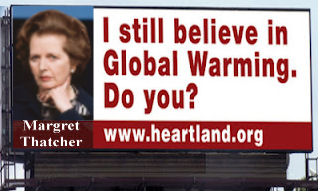
I have been following the news of Heartland's ill judged ad campaign. I'd say ill judged only if you consider shooting yourself in the foot while it is in your mouth, ill judged.  Didn't they learn anything from the not funny satirical 10:10 ads?

By pretty much suggesting that those who accept the science of global warming are like serial killers and terrorists they have managed to alienate supporters and funders alike. Drink giant Diageo who owns brands like Guinness, Smirnoff, Johnnie Walker and Moët & Chandon and gave Heartland $10,000 over the past two years say they have no plans to work with the Heartland Institute in the future. State Farm an insurance company has also announced that they were severing all ties with the Heartland Institute.This company gave $114,000 in 2010, $230,000 last year and $95,000 this year according to Heartland's leaked fund-raising plan. Ouch!

'my participation in the upcoming Heartland conference has now become untenable.' With her book being advertised on the same Heartland web page she believes her ' reputation has been harmed'. She also reports;
'Ross McKitrick said in an a strongly-worded letter to Heartland yesterday:
You cannot simultaneously say that you want to promote a debate while equating the other side to terrorists and mass murderers.'
Perhaps more can be learned about the ethics and morals of those who appear to see nothing wrong with this sort of campaign. Enter stage left my Member of the European Parliament, Roger Helmer. He became an MEP on a Conservative ticket before defecting to the more extreme right UKIP party who has for a deputy leader Mad Monckton. Helmer has been mentioned on my blog before;
Who voted for this idiot?
Rape victims share responsibility for the crime!
Winds of Change?

Helmer is still down to attend this Heartland conference as a breakfast speaker;
"Breakfast - May 23, 2012: SPEAKER, Roger Helmer, European Parliament, Great Britain - $39.00 "
By all accounts this insidious Ad campaign is no barrier to him giving his speech. According to Leo Hickman;
'He confirmed he was still attending, adding:
I am delighted that the Heartland campaign for the Chicago climate conference has succeeded in its purpose and attracted the attention of the Guardian.'
So with Helmer and his conservative opinions in mind I thought I'd give Heartland a few suggestions for alternatives to their posters. This ones for Rog;


 But Heartland's ads are really a reverse version of the Appeal to Authority. Choose someone who is noteworthy in some respect and use them to promote something unrelated. I can't see dairy farmers being too pleased to see this around the country;


Or, as the title of this post suggests, dog breeders liking this;


But to really show the absurdity and irrationality of this add campaign, suppose an environmental group had commissioned this;


Normal Service Has Been Resumed

After the hack at Steven Goddard Orwellian named 'Real Science' web site that resulted in no posts for several days, normal service has been resumed.

The latest post still rejects science and rationality. It still denies global warming is happening. It still promotes conspiracies including '“Global Warming” to scare the masses and make lots of money while controlling nations'.

The only real difference is that this post isn't from the guy who calls himself Steven Goddard, he still seems to have lost control of his domain, but by someone calling themselves Richard Garwin.

There is a rather eminent physicist called Richard Garwin, now 84 years old, and a Board member of the Union of Concerned Scientists, but this clearly isn't Goddard's hacker.


The post has received quite a lot of interest form Goddard's usual commenters but they seem unhappy with it for some reason and I can't quite put my finger on what it is. Perhaps this Richard Garwin is slightly more extreme in his conspiracy theories with talk of Elitists, Weather Control and UFOs, but it hardly makes less sense that Goddard's 'Birther' conspiracies for example. But what is assured is that their ability to think rationally remains just as impaired;

'Ano' suspects the hack could be down to the warmists;
I would suspect it might be a guy from Desmog Blog. This is their kind of thing
 'Dave Burton' agrees;
I suspect that the person impersonating Richard Garwin is a climate alarmist having some fun at skeptics’ expense.

Meanwhile, normal service has been resumed by Steve Goddard himself over at his old Worprdpress blog where his own anti-science, conspiracy theory nonsense continues.

Unfortunately so does the nonsense that the hack was an attack carried out by the warmists, 'ntesdorf' says:
Dirty tricks are all that the Warmists really know.
  And 'Rogelio' says:
I still think that that site was stolen because it is and was really doing major damage to the AGW. I cannot possibly contemplate any other reason
Apparently it was even believed that Richard Garwin the physicist, was responsible for the hack, 'foxgoose' says;
Is he really a Board Member of the Union of Concerned Scientists?
Hilarious!
Obviously they’re a lot more “concerned” than we thought.

 All this despite Goddard's best efforts and continued claims that this incident has nothing to do with either. You really could not make this stuff up.

Ruffled Feathers But No lessons Learned

My previous post on the flaws of Goddard's colouring in and counting project seems to have ruffled a few feathers. Within a few hours he made several posts on sea ice extent, but has not learned from his mistakes - in fact he keeps making the same errors over and over.

In this post he is still colouring in but he doesn't rotate the image this time - what was all that about?


And Mr Goddard now proudly states;
"My pixel counts agree with Cryosphere Today numbers, which show more excess ice in the Bering Sea, than missing ice in the Barents Sea."
 I am at a loss as to why he has gone to the trouble of repeating the same flawed exercise to try and get his pixel count to agree with  Cryosphere Today. Why not just accept the information on Cryosphere Today? Perhaps because it doesn't suggest that the data "should be showing Arctic ice extent slightly above normal, for the first time in nearly ten years", his original and erroneous claim.


But he is still making the same mistakes. I hand you over to  Peter Ellis, a real sceptic and someone who has noticed problems with Goddard's analysis and similar problems with this map as I did in my original post. This is his comment to Steven Goddard;

Peter Ellis says:
April 19, 2012 at 3:33 pm

You count does not agree with Cryosphere Today numbers, since they show a current overall area anomaly of -0.103 million sq km. You can’t just pick two regions and ignore the rest. As far as your pixel count goes, even by eye I can see you missed some pixels in the Greenland sea. But that omits a larger issue: the pixels that comprise the orange line itself. These (being the border of the ice) presumably are ice-covered in the historical mean data. Since we cannot see through the line, we do not know how many of them are ice-covered today. The orange line is several pixels wide and thousands of pixels long. Your count therefore has a minimum error of several thousand, which makes your entire exercise moot.

Regarding the NSIDC figure, the historical average line is not strictly shifted, it’s actually a subtly different shape, since it’s now based on a 5-day average rather than a 9-day average. If you look carefully you’ll see the line is now slightly less smooth.

What does that do to the overall shape? Well, after normalising and taking the current date as day 0, the April 16 graph shows the average of days (-6,-5,-4,-3,-2,-1-0,1,2) , while the April 18th graph shows the average of days (-4,-3,-2,-1,0). That is, there’s no “shift” in that both are centred on day -2, but there is a difference in the size of the smoothing window.

How does the inclusion of days -6,-5,1 & 2 affect the average? Not at all during parts of the year when the rate of gain or loss is ~ linear. However, during this part of the spring, melt is accelerating, and so days 1&2 are further below day -2 than days -6&-5 are above day -2. So, during this part of the year, the 9-day average will be fractionally lower than the 5-day average.

Taken together, that means that going from the 9-day average to the 5-day average, even when correctly centred, will cause the “average” line to rise fractionally. It’s how smoothing works. The reverse will hold true as the melt slows down in August/September, so as we approach the summer minimum the “new” line for the historical average will be fractionally lower than it was on last year’s graphs.
Perhaps it is time Steven Goddard put his crayons away.


Between the science and a hard place

This is Part Two of an excellent post from the Idiot Tracker. Part One.

Part Two: Confidence and Risk

As you sit in what is hopefully a comfy chair, blissfully consuming this fine, robustly flavored, 100% complimentary content, have a moment's sympathy for the lot of the climate blogger. Many are his (or her) woes.

Fer instance, I want to talk to you today about the Scylla and Charybdis of lukewarmism, confidence intervals and risk. I would normally pursue this much as I did in the last installment, by plugging in some lukewarmist assumptions and discussing the results. But the trouble with this, as we saw in Part One, is that even the most conservative lukewarmist predictions imply equilibrium warming greater than 2 degrees C – a condition not seen for millions of years, which climate scientists predict will lead to disaster. In order to talk about the problems of confidence intervals and risk, though, we need a projection that doesn't definitely lead to disaster.

My solution is to pull from the AR4 absolutely the lowest-warming model, based on the lower bound of the 95% confidence interval for the lowest-emission scenario family, B1. This family is described as follows:
    The B1 scenarios are of a world more integrated, and more ecologically friendly. The B1 scenarios are characterized by:
    • Rapid economic growth as in A1, but with rapid changes towards a service and information economy.
    • Population rising to 9 billion in 2050 and then declining as in A1.
    • Reductions in material intensity and the introduction of clean and resource efficient technologies.
    • An emphasis on global solutions to economic, social and environmental stability.
This is a totally unjustifiable procedure on a couple of levels. Obviously at the moment we are not making anything that could be described as rapid progress towards an "integrated . . . ecologically friendly world." Put that to one side. You also cannot simply take the lowest bound of the lowest temperature rise scenario and call that your estimate; that's cherry-picking of the worst kind. But this is the only way to get an estimate this low, so . . . I'm going to have to ask you to play along.

So say I'm a lukewarmer, and I think we're in for about 1.1C in warming over the next century. Add that to the 0.7C seen since the start of the industrial revolution, and you end up with 1.8C of warming – a princely 0.2C below our maximum safe-ish warming of 2C. Provide we do not care anything about what happens after 2100, as for example, in 2120 or 2130, we're golden.

Having ascended to these lofty height of assumption, we can finally deliver the coup de grace (the stress is causing me to mix my metaphors – who would be dealing out mercy killings on a mountaintop?) We have our lukewarmer, and they have their 1.1C by 2100. First question: What is your level of confidence in that projection? Let's look at some real-life estimates of climate sensitivity, based on actual data:
    Royer, et al. (2007)[24] determined climate sensitivity within a major part of the Phanerozoic. The range of values—1.5 °C minimum, 2.8 °C best estimate, and 6.2 °C maximum—is, given various uncertainties, consistent with sensitivities of current climate models and with other determinations.http://en.wikipedia.org/wiki/Climate_sensitivity - cite_note-24

    Annan and Hargreaves (2006)[22] presented an estimate that resulted from combining prior estimates based on analyses of paleoclimate, responses to volcanic eruptions, and the temperature change in response to forcings over the twentieth century. They also introduced a triad notation (L, C, H) to convey the probability distribution function (pdf) of the sensitivity, where the central value C indicates the maximum likelihood estimate in degrees Celsius and the outer values L and H represent the limits of the 95% confidence interval for a pdf, or 95% of the area under the curve for a likelihood function. In this notation their estimate of sensitivity was (1.7, 2.9, 4.9)°C.

    Based on analysis of uncertainties in total forcing, in Antarctic cooling, and in the ratio of global to Antarctic cooling of the last glacial maximum relative to the present, Ganopolski and Schneider von Deimling (2008) infer a range of 1.3 to 6.8 °C for climate sensitivity determined by this approach.[12]

    Andronova and Schlesinger (2001) found that the climate sensitivity could lie between 1 and 10°C, with a 54 percent likelihood that it lies outside the IPCC range.http://en.wikipedia.org/wiki/Climate_sensitivity - cite_note-15
The first thing you likely noticed about these calculations is that to continue to test lukewarmism we have really, really underestimated the magnitude of the warming expected in the 21st century. But the second thing you should notice is that the ranges -- the confidence intervals -- are really large. Climate sensitivity is a fiendishly difficult thing to pin down with precision, and most honest scientists come up with a range of 4-9 degrees C for the sensitivity that may be implied by any given data set or model. Those assimilating the results of many experiments and model runs can do substantially better, with recent estimates of 2.6-4.1C, a range of only 1.5C, or 2.6C if we reach down and include the unlikely possible of a sensitivity of 1.5C.

So the critical question then becomes: what is the lukewarmers' range? Consensus scientists estimate climate sensitivity at about 3C, but concede that it might be 1.5C, 4.5C or even higher (and very unlikely to be much lower). What range do lukewarmers think is plausible?

So far, to my knowledge, no self-identified lukewarmer has been persuaded to answer this question. They will find it difficult. Because they have positioned themselves as participants in the scientific debate, they can hardly claim 100% confidence in X climate sensitivity, no error bars. If they are reasonable, they have to accept they they are as fallible as the rest of the scientific community, and although they think the climate sensitivity is 1.5C (say) it might be 1.0C, or 2.0C, or even (gasp!) 3.0C (where the consensus puts it).

So even if they see 1.5C as the most likely number, they have to concede the possibility the number may be higher or lower. Emissions, too, may be higher or lower -- and so could the 2C estimate for disastrous climate change, which is just an estimate, be low or, what is more likely, high.

And this leads us to the problem of risk. What amount of risk will we accept in the next century that our civilization will be severely affected by global warming? Five percent? One percent? A tenth of one percent?

Put it another way: rapid cuts in emissions are estimated to cost between 1-3% of the GDP. Suppose there is a revolver to your head with a thousand cylinders (it's a big revolver). For a 3% raise, how many chambers are you willing to have loaded before your boss pulls the trigger? One? Maybe if you're hard up. One in a thousand's not a huge chance to take. Ten? Probably not, if you have anything to live for. A hundred? Never in a million years.

People differ in their appetites for risk, but I think most people would agree that a 1% risk of major climate disruptions like multi-meter sea level rise, massive droughts, mass extinctions, and millions of climate refugees, is around the upper limit of acceptable. And that's the end of lukewarmism (again). Any remotely reasonable estimate of climate sensitivity, even if centered on 1.5C or even lower, even if it gives you a central estimate of less than 2C, will carry with it the very significant chance that the real value is 2C or 2.5C or 3C. Traveling with it will be uncertainties about the rate of growth of emissions, and the possibility that less than 2C will get us to planetary disruptions like the rapid melting of most of the ice sheets or large-scale methane release.

Once you've acknowledged the greenhouse warming caused by CO2 and other greenhouse gases, even a ludicrously low estimate of climate sensitivity will not save you from the iron logic of risk assessment: "maybe not" and even "probably not" are unacceptable for the kind of impacts we're talking about. Even 1% is too high. But, absent a new data set allowing a much, much more exactly calculation of climate sensitivity than we have been able to provide to date, there is no way even the most Pollyanna estimates of climate sensitivity and future emissions can provide any acceptable level of assurance that "business as usual" is anything but a road to ruin.

Between the science and a hard place: The intellectual incoherence of lukewarmism.

This is a mirrored post from Idiot Tracker, that is too good not to share.

Part One: jimming the Overton window.


In recent years, the climate wars have witnessed the rise of a group of self-identified "lukewarmers," people who, to borrow Greg Easterbrook's self-description, believe that:
    [G]lobal warming is scientifically confirmed but exaggerated as a threat; that greenhouse gas regulation is justified, but not an emergency need.

The first use of the term I have found was by David Smith, on "Watts Up With That" (a bit of foreshadowing, that):
    I am a “lukewarmer” who thinks that the world is warmer than it would otherwise be due to anthropogenic gases (but doubts that the impact will be extreme).
Probably the most famous "lukewarmer" is Lucia Liljegren, a mechanical engineer (surprise!) whose blog, The Blackboard, can be found on the blogroll here. The Blackboard entertains many lukewarmers, along with a bunch of deniers and a smattering of pro-consensus folks, including myself.

Another self-described lukewarmer, Steven Fuller, has stepped into the giant floppy red shoes of Steven Goddard at WUWT, now that Steve has metastasized to his own blog. His self-description is the closest to providing a clear, testable proposition, as well as reflecting, by my reading, the central thrust of the comments by the "lukewarmers" on The Blackboard:
    It’s because I am a ‘lukewarmer,’ one who believes that the physics of climate change are not by theselves controversial, but who believes that the sensitivity of the earth’s atmosphere to a doubling of concentrations of CO2 is not yet known, but is likely to be lower than activists have claimed.
Before I get into what the climate sensitivity might be, it's important to note who the lukewarmers are, which is slightly different from their self-definition. The lukewarmers to a person are critical of the IPCC, but when we take a look at the estimates of climate sensitivity cited by the IPCC, it's clear that thinking climate sensitivity is low is not enough to get on the outs with them:


Most estimates of climate sensitivity, regardless of how they are derived (and there are several lines of evidence including comparisons with paleoclimate, response to modern forcings like the Mount Pinatubo eruption, and climate modeling) include in their 95% confidence interval sensitivities between 1-2C. In some cases, the central estimate is between 1.2-1.5C for a doubling of CO2. So favoring a low number for climate sensitivity is not, by itself, enough to put you at odds with the "consensus." You need the other piece – the it's-not-a-big-deal piece. And that's where the trouble starts.

There is a half-full glass here, which is that a number of people who clearly identify emotionally and politically with the denialist movement have taken major steps towards the scientific consensus in order to maintain their credibility. While sharing the denialosphere's loathing of "activists" and its demonization of scientists like Hansen and Mann (whose unforgivable sin was to establish beyond a reasoned doubt that humans are causing a rapid and substantially unprecedented warming of the earth's climate) the lukewarmers avoid three major pitfalls of denialism:

1. They do not have to deny the basic physical laws which dictate that greenhouse gases cause warming.

2. They do not have to refute the massive physical evidence that the climate is warming.

3. They do not have to pretend that the vast majority of scientists who accept the theory of AGW are participating in a vast conspiracy to hide the truth about (1) and (2).

The lukewarmist position also allows one to position oneself as a moderate threading the needle between two extremes. Steven Fuller again:
    The operation of CO2 as a greenhouse gas is one of the least controversial ideas in physics. The calculations that show a temperature rise of between 1 and 2 degrees Celsius if concentrations double is also widely accepted, including by all skeptic scientists without (AFAIK) exception.

    We don’t know the sensitivity of the atmosphere to a doubling of CO2, so the effects of feedbacks are not know. Activists think it is 3 degrees or higher. Contrarians think it is very low–1, maybe 2, tops, some thinking it is even lower.
    If activists are right we have a very big problem on our hands. If contrarians are right we don’t. If both are wrong, there is a lukewarmer’s way.
Note that the best science around puts climate sensitivity between 2.6-4.1C. It's not "activists" who put climate sensitivity at around 3C or higher – except as far as the activists are saying: Hey, those scientists that have spent their lives in this field probably are the best source of information regarding climate sensitivity.

The real contrast here is not between "activists" and "skeptics" but between deniers and everybody else – between the science and the right-wing lunacy. But lukewarmers are exploiting the shift in the Overton window brought about by voluble climate deniers to position their radical views as a sane middle ground.

Here's the problem. Lukewarmism doesn't get its adherents where they want to go – because even if we accept at face value their claims, the world would still require intense efforts to reduce the emissions of greenhouse gases in order to stave off disaster.

Scientists estimate a warming of 2C as the upper limit of what our civilization can adapt to, and not suffer disaster on a planetary scale. This is probably an optimistic number:
    … even a “moderate” warming of 2°C stands a strong chance of provoking drought and storm responses that could challenge civilized society, leading potentially to the conflict and suffering that go with failed states and mass migrations. Global warming of 2°C would leave the Earth warmer than it has been in millions of years, a disruption of climate conditions that have been stable for longer than the history of human agriculture. Given the drought that already afflicts Australia, the crumbling of the sea ice in the Arctic, and the increasing storm damage after only 0.8°C of warming so far, a target of 2°C seems almost cavalier.
The hard lower limit of climate sensitivity -- the lowest it can possibly be and account for our direct observations – is about 1.1C (the real number is very likely to be in that range of 2.6C-4.1C – but we are following the "lukewarmist" argument to see where it leads). The change in forcings expected from a "business as usual" 21st century are +8.5W/m^2 – about 2 1/3 doublings of CO2.

Hence with the lowball number – the number Steven Fuller attributes not to lukewarmers but to out-and-out deniers – put us on course for 2.5C of warming this century. In other words, the lukewarmers' own numbers belie their causal attitude to reducing greenhouse emissions.

Now the deniers – sorry, excuse me, the "lukewarmers" – may say the projected emissions are much too high; that the IPCC is way off with those numbers as well. Or they could take the bull by the horns and claim, despite all the evidence to the contrary, that warm can tolerate warming of 3C or 4C without any major problems (the last time the world was that hot was several million years ago; there were no ice caps to speak of and the sea level was hundreds of feet higher). The trouble with that position is that it undermines the whole thrust of lukewarmism – which is to acquire credibility (or, to be fair, possibly to exercise intellectual honesty) via the advantages (1), (2), and (3).

Disputing one point with the scientific community – climate sensitivity – is compatible with a reasonable, pro-science argument. Hey, it happens -- an idea becomes the established consensus, and it turns out to be, not completely wrong maybe, but off (this has already happened several times in climate science -- unfortunately, every time, to date, the majority of the mistakes have been in the direction of under-estimating the speed and magnitude of the effects of global warming.)

However, when you begin to argue that not only does science have climate sensitivity wrong but also emissions and maybe impacts to boot – well, you're going to have a hard time explaining why thousands of scientists have made not one but a series of mistakes, all supposedly exaggerating the dangers of global warming. Go down that road, and pretty soon you're right back in the tinfoil-hat camp lukewarmist rhetoric was supposed to deliver you from. If you allege not one but a whole series of gigantic mistakes by huge numbers of investigators, all tending to undermine a scientific conclusion (only rapid reductions in emissions of greenhouse gases can prevent a substantial risk of planetary disaster) to which you are avowedly hostile, the simplest conclusion is not that you are a genius and the rest of the scientific community are fools; it is that you are a partisan and you are attacking science with implications contrary to your political goals.

In Part 2, I'm going to give the "lukewarmers" even more rope, and show how even widely unrealistic lowballing of climate change fails to make a rational case for business as usual.